
Did you know: Condensation Under Impermeable Pavements
It’s not commonly known that on the underside of impermeable pavements there is often a layer of moisture. This is caused by condensation that forms due to heating and cooling cycles during the day. Tree roots can seek to exploit this moisture, leading to cracked and lifted pavements.
In urban settings, trees are often surrounded by impervious surfaces such as concrete or asphalt pathways. These can act as a barrier that prevents moisture from evaporating from the soil. The moisture instead condenses directly underneath the pavement because of the difference in temperature between the soil and pavement (Randrup et al., 2003).
This condensation layer is attractive to tree roots, made only more attractive by trees’ limited access to water and minerals in the highly compacted soils found underneath impermeable pavements to support pavement loadings (Grabosky et al., 2009). Consequently, tree roots may push up against the pavement, causing cracking or other damage.
The significant maintenance and repair costs required due to this damage may cause reluctance to use trees in urban street designs. Rather than avoiding the use of trees, a solution is simply needed that limits condensation and lowers the temperature under the pavement so that roots do not want to grow at the soil/pavement interface.
Permeable pavement has the potential to solve these problems. Unlike impermeable pavement, permeable alternatives allow stormwater to infiltrate through the surface, filtering through various layers and into the subgrade and tree root zone below. The base layers are self-draining and contain no soil particles. Water and air can pass through these layers as well as the top layer of pavement, so no condensation layer forms. The tree roots therefore do not need to seek out water and nutrients directly under the pavement and are instead encouraged to grow deeper, consequently minimising the incidence of pavement damage by tree roots (Beecham, 2012).
Porous Lane’s semi-flexibility also provides mitigation against cracking due to tree root movement, creating a pavement that provides benefits to pedestrians & vehicles, trees and an asset that provides a long design life in the Tree Protection Zone.
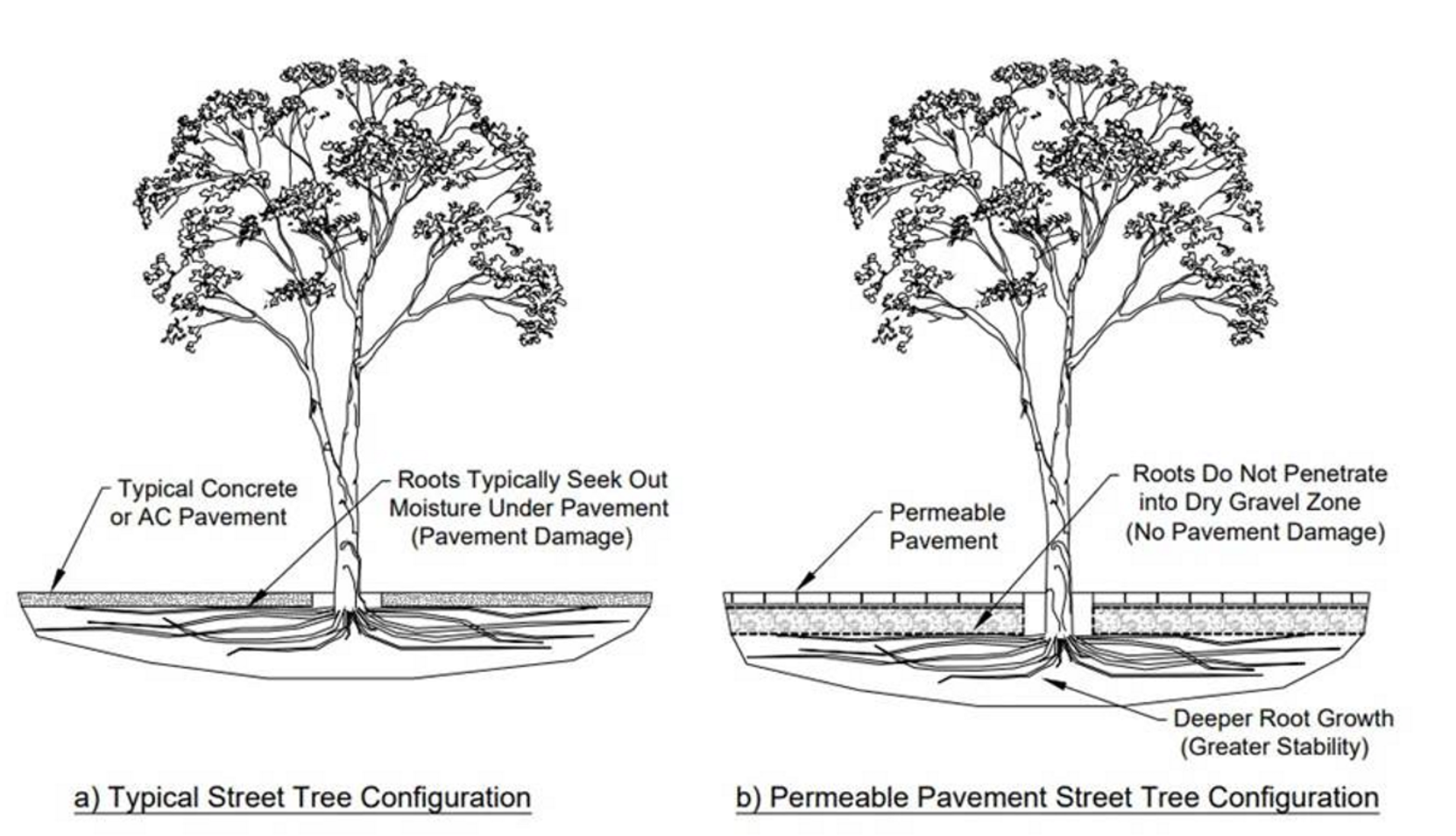
Figure 1. Permeable Pavement with Street Tree Design Concept (Beecham, 2012).
References
Beecham S (2012) Trees as essential infrastructure: Engineering and design considerations, TreeNet.
Grabosky J, Haffner E and Bassuk N (2009) Plant available moisture in stone-soil media for use under pavement while allowing urban tree root growth, Arboriculture & Urban Forestry, 35(5), 271-278.
McPherson E G (2000) Expenditures associated with conflicts between street tree root growth and hardscape in California, USA, Journal of Aboriculture, 26(6), 289-297.
Randrup T B, McPherson E G and Costello L R (2001) A review of tree root conflicts with sidewalks, curbs and roads. Urban Ecosystems, 5, 209-225.
Roberts J, Jackson N and Smith M (2006) Tree roots in the built environment. Vol. 8. Research for Amenity Trees The Stationery Office, London.